


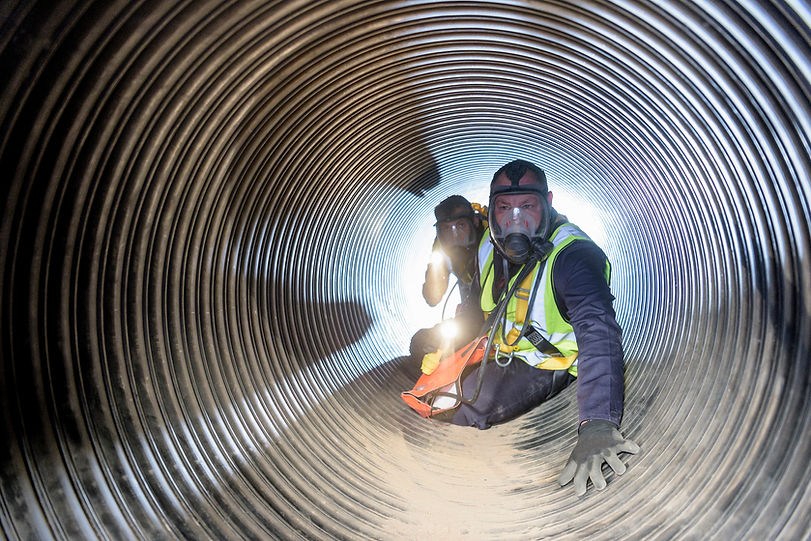
Safety Training for Working in Confined Spaces
At Total Safety UK we lead the way when it comes to training personnel to work in hazardous conditions. Take a look at our safety training courses for working in confined spaces and get in touch to book.
This course is designed for workers who operate within a low risk confined space across a wide variety of industries. The aim of this unit is to assess learners against the National Occupational Standard in a realistic low risk environment, by preparing to work in, enter and exit confined space safely; use equipment and tools safely, follow procedures and dealing with emergencies.
Course Duration
This is a 1-day course.
Maximum attendees: 10 delegates.

Assessment & Certification
-
Practical observation - side entry and top entry no deeper than 3 metres
-
Undertaking risk assessments throughout the exercise to identify hazards
-
Responding to risks and hazards
-
Dealing promptly with emergencies
-
Short answer question paper
Delegates successfully completing the course will be issued with certification which is valid for 3 years.
Course Content
-
Confined Space Regulations 1997 & Approved Code of Practice L101
-
Definition of a confined space
-
National Classifications of confined spaces
-
Apply industry standards
-
Potential hazards & additional risk
-
Risk Assessments, Permit to Work & POWRA
-
Medical Requirements for entry into confined spaces
-
Communications
-
Oxygen deficiency, Toxicity, Combustibility & Physical hazards
-
Ventilation
-
Isolations
-
Diseases & First Aid
-
Decontamination
-
Lone Working
-
Use appropriate behaviour for working in low risk confined spaces.
This course is designed for workers who operate within a medium risk confined space across a wide variety of industries. The aim of this unit is to assess learners against the National Occupational Standard in a realistic medium risk environment; preparing to working safely; entering and exiting confined space safely; preparing and using appropriate respiratory protective equipment (RPE); using equipment and tools safely; following procedures and dealing with emergencies.
Course Duration
This is a 2-day course.
Maximum attendees: 8 delegates.

Assessment & Certification
-
Practical observation - side entry and top entry no deeper than 3 metres
-
Undertaking risk assessments throughout the exercise to identify hazards
-
Responding to risks and hazards
-
Dealing promptly with emergencies
-
Short answer question paper
Delegates successfully completing the course will be issued with certification which is valid for 3 years.
Course Content
-
Confined Space Regulations 1997 & Approved Code of Practice L101
-
Definition of a confined space
-
National Classifications of Medium Risk confined spaces (NC2/3)
-
Apply relevant industry standards
-
Duties of an Entry Controller/Entrant
-
Potential hazards & additional risks
-
Risk Assessments, Permit to Work & POWRA
-
Use appropriate behaviour and knowledge
-
Equipment, including, Tripod & Fall Arrest Winch etc
-
Safety harnesses
-
Emergency Escape Breathing Apparatus
-
Communications
-
Atmospheric monitoring
-
Ventilation
-
Isolations
-
Diseases & First Aid
-
Medical requirements for entry into confined space
-
Decontamination
This course is designed for workers who operate as part of a team within a high risk confined space. The aim of this unit is to assess learners against the skills and knowledge required by a worker operating in a high risk confined space environment.
Course Duration
This is a 2-day course.
Maximum attendees: 8 delegates.

Assessment & Certification
-
Practical observation - side entry and top entry no deeper than 3 metres
-
Undertaking risk assessments throughout the exercise to identify hazards
-
Responding to risks and hazards
-
Dealing promptly with emergencies
-
Short answer question paper
Delegates successfully completing the course will be issued with certification which is valid for 3 years.
Course Content
-
Confined Space Regulations 1997 & Approved Code of Practice L101
-
Definition of a confined space
-
National Classifications of confined space
-
Potential hazards & additional risks
-
Apply relevant industry standards
-
Duties of an Entry Controller
-
Risk Assessments, Permit to Work & POWRA
-
Atmospheric Monitoring
-
Medical requirements for entry into confined space
-
Communications
-
Ventilation
-
Isolations
-
Diseases & First Aid
-
Decontamination
-
Lone Working
-
Safety Harnesses
-
Tripod & Fall Arrest Winch etc
-
Emergency Escape Breathing Apparatus
-
Self-Contained Full Duration Breathing Apparatus
- Air-line systems (Drager Airpak 1 with Colt and or Scott Modular Air with Flite/COV)
The aim of this unit is to reflect the National Occupational Standard to impart knowledge and skills to those persons who may be involved in planning, organising and managing work safely in confined spaces. This training programme is designed for those responsible for organising and planning work activities within a confined space. The manager may or may not supervise the actual job. (Emphasis on hazards / controls, use of documents associated with confined space entries, use of environmental monitoring equipment, access equipment, escape breathing apparatus.)
Course Duration
This is a 1-day course.
Maximum attendees: 10 delegates.

Who Should Attend?
Managers and supervisors (Responsible Persons) who are involved in the planning and managing of confined space activities.
Prerequisites
Delegates MUST hold a recognised confined space course and be responsible for managing confined space activities.
Assessment & Certification
Course Content
-
Plan the management of work in confined spaces
-
Manage confined space teams
-
Record and review legislation relating to confined spaces
-
Develop, monitor and confirm procedures for working in confined spaces
-
Understand environmental, legislative and health and safety compliance
-
Understand organisational requirements for confined space working
-
Understand plant, tools and equipment for working in confined spaces
-
Understand emergency arrangements and rescue plans
-
Written exercises – writing a Permit to Work & Risk Assessment
-
Written examination
Delegates successfully completing the course will be issued with certification which is valid for 3 years.
This course covers how to work safely in high risk confined spaces when a specified risk cannot be eliminated or controlled to an acceptable level without the use of respiratory protection (breathing apparatus). Candidates will experience an environment containing one or more of the specified risks (fire / explosion; loss of consciousness from an increase in body temperature; loss of consciousness or asphyxiation from gas, fume, vapour or lack of oxygen; drowning from an increase in the level of liquid and asphyxiation of any person from free flowing solid). Entry to the confined space may involve complex entry procedures. It will entail the use of breathing apparatus (RPE).
This course also covers how to be a member of a team for rescue and recovery of casualties from confined spaces should an emergency arise. It will entail the use of breathing apparatus (RPE).

Course Duration:
3.0 or 4 days depending upon delegate numbers
Ratio:
1:8
Prerequisites:
Medically fit with a reasonable level of fitness and a suitability to work within confined space environments. Delegates MUST be clean shaven.
Who Should Attend?
Personnel who work within a high risk confined space environment or are employed to act as an emergency rescue team member, these could include: telecommunication engineers, construction, water utilities, factory workers, Oil and Gas operatives, Renewable engineers, dock yard workers and shipping.
Validity:
3 years
Course Content
-
Prepare to enter and work safely in High Risk Confined Space
-
Use general knowledge for working in High Risk Confined Space and their environments
-
Prepare to work safely in confined spaces under emergency conditions
-
Enter and exit confined spaces safely
-
Prepare and use breathing apparatus in accordance with manufacturers’ specifications
-
Use equipment and tools safely and in accordance with manufacturers’ instructions
-
Follow procedures and work safely
-
Deal with emergencies
-
Work with others
This course aims to reflect the National Occupational Standard for a low risk related confined space environment as well as the National Classifications. It covers both water and non-water industry areas.
Water: this may include working with potable water, sewage treatment processes, drain and sewer cleaning operations or where the operative is working in or near water or where a confined space is subject to surface water flooding.
Non-water: this may include pharmaceutical, petrochemical, asbestos removal, vehicle manufacture and servicing, aeronautical.

Course Duration
This is a 1-day course.
Maximum attendees: 10 delegates.
Who Should Attend?
This course is aimed at anyone working in a low-risk environment and includes preparing to enter and work safely, entering and exiting confined spaces safely, using equipment and tools, following procedures and dealing with emergencies.
Course Content
-
Prepare to work safely in a low risk confined space
-
Enter and exit a low risk confined space safely
-
Use equipment and tools safely
-
Follow working procedures and work safely
-
Deal with emergencies
-
Understand the principles of working in a low risk confined space
Assessment & Certification
-
Practical observation - side entry and top entry no deeper than 3 metres
-
Undertaking risk assessments throughout the exercise to identify hazards
-
Responding to risks and hazards
-
Dealing promptly with emergencies
-
Examination and practical assessment
Delegates successfully completing the course will be issued with a certification by C&G after, which is valid for 3 years.
This course aims to reflect the National Occupational Standard for controlling entry and entering a medium risk confined space. It covers both water and non-water industry areas.
Water: this may include working with potable water, sewage treatment processes, drain and sewer cleaning operations, or where the operative is working in or near water, or where a confined space is subject to surface water flooding.
Non-water: this may include pharmaceutical, petrochemical, asbestos removal, vehicle manufacture and servicing, aeronautical, of work operations in mines, quarries and tunnelling
Who Should Attend? This course is aimed at anyone working or preparing to work in a medium risk environment or those working as entry controller, controlling entry and arrangements for medium risk confined spaces. It includes entry controller duties, pre-entry procedures, entry into and exit from a medium risk confined space, using equipment and tools safely, maintaining communications and initiating and controlling emergency procedures.
Course Content
-
Prepare to work safely at medium risk confined spaces
-
Enter and exit the medium risk confined space safely
-
Work safely and monitor the work team to ensure procedures are followed
-
Deal with emergency situations
-
Understand the principles of working in medium risk confined spaces
-
Understand standard protocols for work in medium risk confined spaces
-
Understand entry controller duties and responsibilities
-
Understand equipment checks and inspection required
Assessment & Certification
Delegate to carry out a written examination and practical assessment. Delegates successfully completing the course will be issued with a certification by C&G after, which is valid for 3 years.
Course Duration
This is a 2-day course.
Maximum attendees: 8 delegates.
This course aims to reflect the National Occupational Standard for a high risk related confined space environment. It covers both water and non-water industry areas.
Water: this may include working with potable water, sewage treatment processes, drain and sewer cleaning operations, or where the operative is working in or near water, or where a confined space is subject to surface water flooding.
Non-water: this may include pharmaceutical, petrochemical, asbestos removal, vehicle manufacture and servicing, aeronautical, of work operations in mines, quarries and tunnelling

Who Should Attend? This course is aimed at anyone working in a high risk environment and includes preparing to work safely, entering and exiting high risk confined spaces safely, using equipment and tools safely, following procedures and dealing with emergencies.
Course Content
-
Prepare to work safely in a high risk confined space
-
Enter and exit a high risk confined space safely
-
Use equipment and tools safely
-
Follow working procedures and work safely
-
Deal with emergencies
-
Understand the principles of working in a high risk confined space
-
Understand the standard protocols of working in a high risk confined space
Assessment & Certification
-
Practical observations - side entry and top entries, utilising breathing apparatus
-
Undertaking risk assessments , POWRA's, & Permit to Works etc Responding to risks and hazards
-
Dealing promptly with emergencies
-
Examination and practical assessment
Delegates successfully completing the course will be issued with certification which is valid for 3 years.
Course Duration
This is a 3-day course.
Maximum attendees: 8 delegates.
The aim of this unit is to reflect the National Occupational Standard for working as a rescue and recovery team member in confined spaces. This unit covers both water and non-water industry areas
Water: this may include working with potable water, sewage treatment processes, drain and sewer cleaning operations, or where the operative is working in or near water, or where a confined space is subject to surface water flooding.
Non-water: this may include pharmaceutical, petrochemical, asbestos removal, vehicle manufacture and servicing, aeronautical, construction, communications, power, utilities, gas, electrical and mechanical engineering and some elements of work operations in mines, quarries and tunnelling

Who Should Attend?
This unit is for anyone who works as part of a rescue and recovery team in confined spaces. It includes preparing to carry out emergency activities, entering and exiting confined spaces safely, using emergency equipment, casualty recovery and handling devices in accordance with manufacturers' specifications, rescuing and recovering casualties, following procedures and working safely
Course Duration
This is a 3-day course.
Maximum attendees: 8 delegates.
Course Content
-
Oversee safety checks of the entry and rescue teams prior to commencing work activities.
-
Enter and exit confined spaces safely as part of a rescue and recovery team
-
Use equipment and tools safely
-
Follow procedures and work safely as a member of a rescue and recovery team
-
Understand the principles of working as part of a rescue and recovery team
-
Understand standard protocols for working in rescue and recovery teams
Assessment & Certification
-
Practical observations - side entry and top entry rescues, utilising breathing apparatus, airlines and a selection of stretchers
-
First Aid - D>R>c>A>B>C
-
Reviewing risk assessments, POWRA's, & Permit to Works etc
-
Dealing promptly with emergencies
-
Examination and practical assessment
Delegates successfully completing the course will be issued with a certification which is valid for 3 years.
The aim of this unit is to reflect the National Occupational Standard for planning, managing and reviewing legislative and safety compliance for work in confined space. This unit is for managers who are responsible for organising planning and managing work in confined space. The manager may or may not supervise the actual job. It involves managing the work of others in, or at confined spaces; reviewing legal requirements; ensuring safety compliance; preparing procedures and appropriate documentation; and making suitable arrangements for dealing with emergencies.
Who Should Attend?
Managers and supervisors (Responsible Persons) who are involved in the planning and managing of confined space activities.

Prerequisites:
Delegates MUST hold a recognised high-level qualification within H&S and have extensive knowledge of a high risk confined space and be responsible for managing confined space activities.
Course Duration
This is a 4-day course. (TQT-75hrs)
Maximum attendees: 10 delegates
Course Content
-
Plan the management of work in confined spaces
-
Manage confined space teams
-
Record and review legislation relating to confined spaces
-
Develop, monitor and confirm procedures for working in confined spaces
-
Understand environmental, legislative and health and safety compliance
-
Understand organisational requirements for confined space working
-
Understand plant, tools and equipment for working in confined spaces
-
Understand emergency arrangements and rescue plans
Assessment & Certification
Portfolio based on planning and managing work arrangements at high risk confined spaces will be required within a set timetable of (10 weeks) These will be assessed by the centre and quality assured by City & Guilds.
Delegates successfully completing the course will be issued with certification which is valid indefinitely providing continuous professional development is maintained.
This course is designed for delegates acting as the Top-Person in controlling the entry and exit of others into confined spaces and also the arrangements that need to be in place to keep them safe while they are there. It includes controlling the pre-entry procedures and entry into and out of confined spaces, maintaining communications with team members who are in confined space, monitoring equipment readings, raising the alarm and handing over to rescue teams during emergency situations. This course is for the safety attendant or Entry Controller who controls entry and arrangements for confined spaces without entering them.
Who Should Attend?
Personnel who work undertake the role of Top-Person to ensure the health, safety and welfare of entrants entering and working within a confined space. These could include: telecommunication engineers, construction, rope access technicians, water utilities, factory workers, Network Rail, Oil and Gas operatives, Renewable engineers, dock yard workers and shipping.

Prerequisites:
Medically fit with self-declaration. This course does not require or facilitate entry into confined spaces.
Course Duration
This is a 1-day course.
Maximum attendees: 10 delegates
Course Content
Validity : 3 years
-
Prepare to act as safety attendant for teams working in confined spaces
-
Oversee the safe entry and exit to confined spaces
-
Monitor the work team to ensure procedures are followed
-
Deal with emergencies
-
Confined spaces and their environment
-
Equipment and tools
-
Working with others and Safely
-
Behaviours - You work in a manner which is vigilant to possible risks and hazards
-
Multi-choice examination
This training course covers how to operate safely as a member of a rescue team who may need to rescue and recover a casualty from a confined space. Open circuit full duration breathing apparatus will be used covering set description and fault finding following a general check, donning and starting procedures, followed by safe doffing procedures upon exiting for hazardous area. A broad range of equipment will be used including stretchers, tripod, winches, O2 therapy and Entonox. The training environment will include shafts, vessels, tunnels, voids etc. using a man-riding winch, rope systems and a retrieval device connected to a davit or tripod to gain entry. The training is general to working within a confined space and working at height but focus’s very much on the industrial/urban environment.
Who Should Attend?
Personnel who work within a high risk confined space environment or are employed to act as an emergency rescue team member, these could include: telecommunication engineers, construction, water utilities, factory workers, Oil and Gas operatives, Renewable engineers, dock yard workers and shipping.

Prerequisites:
Delegates attending this course MUST hold a current High Risk Confined Space qualification and be clean shaven.
Course Duration
This is a 2-day course.
Maximum attendees: 6 delegates
Validity : 3 years
Course Content
-
Legislation
-
Use appropriate knowledge for carrying out emergency rescue and recovery of casualties from a confined space
-
Apply relevant industry standards for carrying out emergency rescue and recovery of casualties from a confined space
-
Prepare to work safely in a confined space under emergency conditions
-
Enter and exit a confined space safely
-
Prepare and use appropriate respiratory protective equipment (RPE) in accordance with manufacturer’s instructions
-
Use rescue equipment safely and in accordance with manufacturer’s instructions
-
Follow procedures and work safely
-
Deal with an emergency situation
-
Use appropriate behaviour for carrying out emergency rescue and recovery of casualties from a confined space
-
Practical exercises
-
Practical assessment
-
Written examination
This course is intended for delegates who require the knowledge to allow them to apply safe working practices, reducing unnecessary risk when entering or working in confined space environments.
The training can be undertaken at our facility, which replicates real life environments and allows for extensive quality feedback due to the infra-red camera recording facility or conducted at the clients site/facility utilising Total Safety’s mobile confined space training unit.
Who Should Attend: Personnel who work within a medium risk confined space environment, these could include: telecommunication engineers, construction, water utilities, factory workers, Oil and Gas operatives, Renewable engineers, dock yard workers and shipping.

Prerequisites:
Medically fit with a reasonable level of fitness and a suitability to work within confined space environments.
Course Duration
This is a 1-day course.
Maximum attendees: 8 delegates
Validity : 3 years
Course Content
• Current legislation and ACOP
• Definition of a confined space
• Permit to work and risk assessments
• Dangers associated with confined space
• Appreciation of the different types of atmospheres
• Use of gas detection equipment
• Diseases and personal hygiene associated with confined space
• Use of Personal Fall Protective Equipment, i.e. harness, fall arrest and restraint lanyards
• Use of Escape Breathing Apparatus sets, including positive pressure, hood and rebreathers • Pre-entry checks on equipment
• Safe systems of work for entry into a confined space
• Methods of communication
• Emergency procedures
• Vertical entry and egress using a tripod, davit and retrieval/man-riding winches
• Awareness of the need for periodic examinations of equipment
• Top-man (Supervisor) role and responsibilities
This course is designed to enable the rescue of a person within a Confined Space from a broad range of structures including shafts, vessels, Oil platform legs, transition piece, tunnels, and voids using a simple wire system. The training is general to working within a confined space and rescue but focus’s very much on Construction, Renewables, Oil & Gas and the Water Utilities industry. On completion of training those attending should be capable of assessing the risk associated within a confined space on a range of different structures found within industry, be competent in the use of full duration breathing apparatus and escape breathing apparatus and carrying out a rescue using a wire system and SKED stretcher or stretcher appropriate to clients requirements.
Who Should Attend: Personnel who work within a high risk confined space environment or are employed to act as an emergency rescue team member, these could include: telecommunication engineers, construction, water utilities, factory workers, Oil and Gas operatives, Renewable engineers, dock yard workers and shipping.

Prerequisites:
Medically fit with a reasonable level of fitness and a suitability to work within confined space environments. Delegates MUST be clean shaven.
Course Duration
This is a 2 or 3 day course.
Maximum attendees: 8 delegates
Validity : 3 years
Course Content
• Legislation
• Safe systems of work, including Work Permits and Risk Assessments
• Safety Equipment
• Knowledge of confined space specified risks
• Atmospheric testing
• Full duration breathing apparatus
• BA Entry Control Procedures
• Entry Controller
• Escape breathing apparatus (Drager and Scott sets)
• Casualty packaging
• Communications
• Route recognition
• Capable of rescuing a person from within a confined space using;
o Tri-pod
o Retrieval winch
o Man-riding winch
o Full Duration Breathing Apparatus
o Air-line system
o SKED Stretcher or equivalent

